In 2023, the IPCC deemed it highly unlikely that the AMOC would collapse by the end of the century. In a recent letter, some experts believe that this risk has been underestimated. What is this current? How does it influence the climate? Is its collapse imminent? What would be the consequences?
With
Didier Swingedouw Climatologist at the Environnements et Paléoenvironnements Océaniques et Continentaux (EPOC) laboratory in Bordeaux.
Pascale Lherminier Physicist at Ifremer, UMR LOPS in Brest.
Global warming is threatening a vast set of marine currents in the Atlantic Ocean: the AMOC. According to 43 international experts, we have underestimated the risks of shutting it down. What would be the consequences?
The AMOC is a system of ocean currents, of which the Gulf Stream is a part. It is one of the major drivers of climate, playing a crucial role in redistributing heat around the planet, and is one of the reasons why our climate in Western Europe is temperate. In a recent letter, experts stress the collateral effects of its slowing down, or even its collapse. Because this is now a probable risk.
https://www-iuem.univ-brest.fr/wp-content/uploads/2025/02/IMG_6231.jpg4231210Benoit Soyerhttps://www-iuem.univ-brest.fr/wp-content/uploads/2018/06/iuem-logo-header.pngBenoit Soyer2025-02-07 11:44:532025-02-07 16:04:14AMOC, the climate against the current – Pascale Lherminier, UMR LOPS, on France Culture
Grégory Charrier, lecturer at the UBO and head of the SML biology master’s programme, will be giving a presentation of the course on 11 February from 6 to 8 pm during a live broadcast on the Youtube platform.
This live event will provide an opportunity to present the content and objectives of the course and to explain the application procedures for Master 1 and Master 2.
The live recording will remain available for later viewing.
https://www-iuem.univ-brest.fr/wp-content/uploads/2025/02/YTLive-Master-Bio2025-main.jpg4231210Sebastien Hervehttps://www-iuem.univ-brest.fr/wp-content/uploads/2018/06/iuem-logo-header.pngSebastien Herve2025-02-06 11:08:532025-02-06 11:09:10Youtube Live presentation of the SML Biology Masters on 11 February from 6pm to 8pm
On 18 November 2024, the annual Brest-Iroise Workshop Zone (ZABrI ) Day was held at the Institut Universitaire Européen de la Mer (IUEM) in Plouzané. Attended by 60 participants, the central theme of the event was co-construction between scientists and local stakeholders. The aim was to explore and strengthen collaboration to improve understanding and management of socio-ecosystems.
Enriching discussions on co-construction
The day began with an introduction and presentations of projects illustrating the diversity of multidisciplinary and transdisciplinary approaches. Participants were able to discover, among other things, the ETICS project on the development of innovative methods based on molecular biology for trophic ecology and the DYNARADE project, focusing on the shared management of coastal environments in the Brest harbour, with the example of the Spartina.
Three thematic sessions followed, offering a variety of perspectives on co-construction. The presentations highlighted the importance of close cooperation between researchers, local authorities, associations and other stakeholders in tackling environmental issues. Inspiring examples, highlighting, for example, the role of biosphere reserves in strengthening partnerships, participatory observation approaches, the involvement of local authorities in governance, the importance and methods of mediation in sharing knowledge and transforming practices, illustrated the diversity of projects and partnership dynamics carried out in the ZABrI and the other Workshop Zones.
Collaborative workshops to build the future
The second part of the afternoon was devoted to workshops. Divided into groups, the participants considered co-construction approaches in conjunction with different types of stakeholder: local authorities, civil society and natural environment managers. These discussions helped to identify levers for action to enhance collaboration and improve existing practices.
An action-oriented conclusion
At the end of the day, the workshops were summed up in a summary of the discussions and proposals, confirming the participants’ commitment to continuing this collaborative dynamic. Fred Jean, Director of the IUEM, brought the event to a close by stressing the importance of strengthening the links between science and territory in the face of environmental challenges.
The day’s events were a great success, providing food for thought on how to build close, lasting partnerships to serve socio-ecosystems. The cross-disciplinary approach adopted by ZABrI illustrates how research can be part of a collective approach to meeting local and global environmental challenges.
https://www-iuem.univ-brest.fr/wp-content/uploads/2025/02/JA-Zabri-2024.jpg4231210Sebastien Hervehttps://www-iuem.univ-brest.fr/wp-content/uploads/2018/06/iuem-logo-header.pngSebastien Herve2025-02-03 09:43:402025-02-03 10:54:04A report on the Brest-Iroise Workshop Zone’s annual day: between science and territory
Faculty of Science and Technology: Masters in Biology, Biotechnology, Marine Chemistry, Physics, STPE (Earth, Planetary and Environmental Sciences)
Faculty of Law, Economics, Management and AES: Masters in Applied Economics (E2AME), Law of Maritime Spaces and Activities (DEAM)
Faculty of Arts and Humanities: Environmental Management (EGEL)
All the information about the UBO Open Days can be found on the university website.
The IUEM will not be opening its doors in Plouzané this year, but in 2026.
https://www-iuem.univ-brest.fr/wp-content/uploads/2025/01/JPO2025-Main-1.png4231210Laure De Montbronhttps://www-iuem.univ-brest.fr/wp-content/uploads/2018/06/iuem-logo-header.pngLaure De Montbron2025-01-30 08:53:552025-01-30 08:57:47UBO open days in Brest
https://www-iuem.univ-brest.fr/wp-content/uploads/2025/01/IUEM-Voeux-2025-main.jpg4231210Sebastien Hervehttps://www-iuem.univ-brest.fr/wp-content/uploads/2018/06/iuem-logo-header.pngSebastien Herve2025-01-27 16:06:432025-01-27 16:06:43Happy New Year 2025
Are you familiar with Nature-based Solutions (NBS)? The idea is to work with nature, not against it!
The concept is based on approaches that combine the protection, management and restoration of natural ecosystems to meet a range of societal challenges. By drawing inspiration from ecosystems themselves, these solutions offer environmental, economic and social benefits while promoting biodiversity.
Created in 2023, the PEPR SOLU-BIOD is an ambitious programme dedicated to the production of knowledge on SfN. Bringing together 60 research teams and 160 local players, the programme will run until 2032, with the aim of supporting far-reaching and sustainable changes in society.
Among the initiatives supported by this programme, the Ponant Living Lab, led by Adélie Pomade, focuses on the tip of Brittany, in particular around the Bay of Brest and the Iroise Sea. This regional initiative explores the potential of SfN to meet local challenges.
The first Ponant Living Lab 2025 steering committee meeting was held on Tuesday 21 January, bringing together a number of partners including the Parc Naturel Régional d’Armorique, the Conservatoire Botanique National de Brest, the UBO, Ifremer, the CNRS and many others. After a morning of discussions, a field trip at the Bindy Point and the Roz Cove provided an opportunity to observe the spartina and the potential of nature-based solutions, in the presence of local elected representatives and stakeholders.
From 7 to 11 July 2025, the World Maritime Campus and UBO will be jointly organising a course entitled ‘Understanding the environmental challenges of the maritime economy’. The course will take place in Brest and Roscoff and, like the previous edition, will be organised in two sessions: an introductory session and a more in-depth session.
Registration is open until 30 April 2025 at this link.
https://www-iuem.univ-brest.fr/wp-content/uploads/2025/01/C3EM-2025-main.jpg4231210Sebastien Hervehttps://www-iuem.univ-brest.fr/wp-content/uploads/2018/06/iuem-logo-header.pngSebastien Herve2025-01-27 12:10:042025-01-27 12:10:042025 edition of the course “Understanding the environmental challenges of the maritime economy”
The third China-Europe Border Forum on Advances in Ocean Science and Technology (FFPOST2) was held in Shanghai and on-line on 18 and 19 November 2024. It was organised by Paul Tréguer (IUEM-UBO, European Academy of Sciences EurASc) and Jing Zhang (ECNU, Chinese Academy of Sciences), as part of the United Nations Decade of Ocean Sciences for Sustainable Development (2021-2030).
About 50 participants attended, with livestreams occurring about 6000 persons. Twenty-four invited speakers presented communications. Progress are remarkable regarding the usability of Ditigal twin oceans and of the AI in physics and biogeochemistry and in coastal management. All carbon dioxide removal (CDR) deployments will lead to compensatory CO2 efflux or reduced influx from all natural reservoirs, stressing the need for all realistic land-based, ocean-based and blue carbon CDR. Carbon sinks due to fisheries are being assessed, extension of the Oxygen Minimum Zone has been shown. Impacts of sea-level rise and extreme events like heat waves are key issues for the near future. First economic costs of the flooding of the coastlines are now available. Spectacular progress in observation tools and networks of the ocean have been highlighted.
https://www-iuem.univ-brest.fr/wp-content/uploads/2024/12/FFPOST2-Main.jpg4231210Sebastien Hervehttps://www-iuem.univ-brest.fr/wp-content/uploads/2018/06/iuem-logo-header.pngSebastien Herve2024-12-06 12:34:472024-12-06 12:34:47Report : “third China–Europe Frontier Forum on “Progress in Ocean Science and Technology”
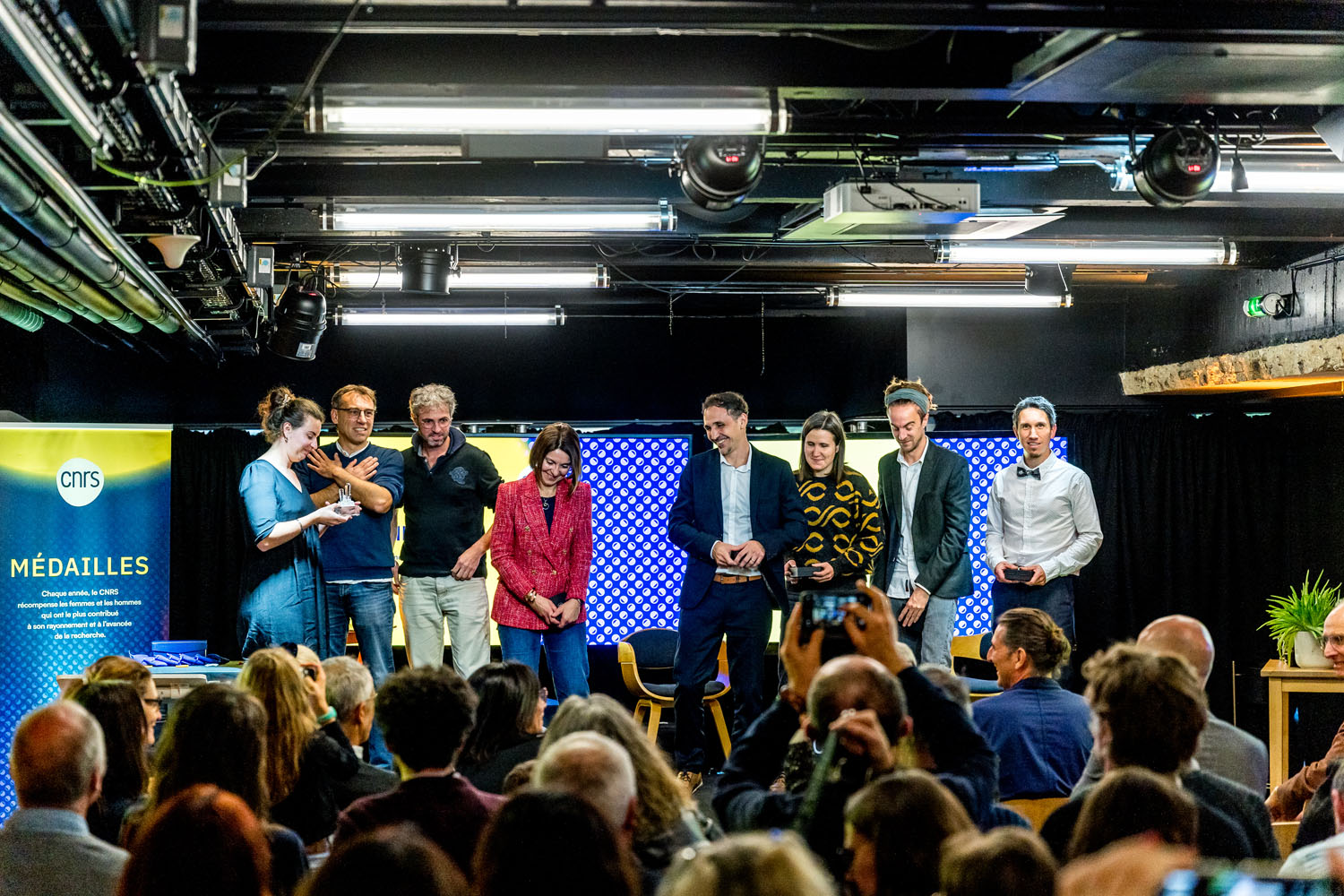
On Tuesday 19 November 2024, the CNRS medals ceremony for the Brittany and Pays de la Loire delegation was held at the Mabilay in Rennes. 5 medals and a collective crystal were awarded ‘to those who, through the originality, quality and importance of their work, have enhanced the reputation of the region and made an exceptional contribution to the dynamism and renown of the institution’. The winners include Damien Desbruyères, an Ifremer researcher in oceanography at LOPS, and the ‘national oceanographic instrumentation park’ team from the INSU Technical Division. Congratulations to them all! Here is the list of medal winners:
Collective Crystal Medal: ‘Parc national instrumentation océanographique’ team (DT INSU) – CNRS Terre & Univers – Representatives : Emmanuel DE SAINT-LEGER and Arnaud LE RIDANT
A fuller article is available on the CNRS regional delegation website.
Pictures : Pierre Theiller/ CNRS Bretagne et Pays de la Loire
For several years, IUEM has been using Twitter to communicate with as wide an audience as possible. However, since Elon Musk bought the platform at the end of 2022, the social network, now known as ‘X’, has evolved in a direction that runs counter to our values: relativism, massive propagation of false information, cyber-bullying, lack of moderation, commercial spamming, etc. The IUEM and the laboratories it hosts have therefore decided to leave this platform.
We remain fundamentally committed to open science that speaks to as many people as possible, and invite you to join our community on LinkedIn.
AMOC, the climate against the current – Pascale Lherminier, UMR LOPS, on France Culture
newsIn 2023, the IPCC deemed it highly unlikely that the AMOC would collapse by the end of the century. In a recent letter, some experts believe that this risk has been underestimated. What is this current? How does it influence the climate? Is its collapse imminent? What would be the consequences?
With
Global warming is threatening a vast set of marine currents in the Atlantic Ocean: the AMOC. According to 43 international experts, we have underestimated the risks of shutting it down. What would be the consequences?
The AMOC is a system of ocean currents, of which the Gulf Stream is a part. It is one of the major drivers of climate, playing a crucial role in redistributing heat around the planet, and is one of the reasons why our climate in Western Europe is temperate. In a recent letter, experts stress the collateral effects of its slowing down, or even its collapse. Because this is now a probable risk.
Youtube Live presentation of the SML Biology Masters on 11 February from 6pm to 8pm
news, SML NewsGrégory Charrier, lecturer at the UBO and head of the SML biology master’s programme, will be giving a presentation of the course on 11 February from 6 to 8 pm during a live broadcast on the Youtube platform.
This live event will provide an opportunity to present the content and objectives of the course and to explain the application procedures for Master 1 and Master 2.
The live recording will remain available for later viewing.
A report on the Brest-Iroise Workshop Zone’s annual day: between science and territory
newsOn 18 November 2024, the annual Brest-Iroise Workshop Zone (ZABrI ) Day was held at the Institut Universitaire Européen de la Mer (IUEM) in Plouzané. Attended by 60 participants, the central theme of the event was co-construction between scientists and local stakeholders. The aim was to explore and strengthen collaboration to improve understanding and management of socio-ecosystems.
Enriching discussions on co-construction
The day began with an introduction and presentations of projects illustrating the diversity of multidisciplinary and transdisciplinary approaches. Participants were able to discover, among other things, the ETICS project on the development of innovative methods based on molecular biology for trophic ecology and the DYNARADE project, focusing on the shared management of coastal environments in the Brest harbour, with the example of the Spartina.
Three thematic sessions followed, offering a variety of perspectives on co-construction. The presentations highlighted the importance of close cooperation between researchers, local authorities, associations and other stakeholders in tackling environmental issues. Inspiring examples, highlighting, for example, the role of biosphere reserves in strengthening partnerships, participatory observation approaches, the involvement of local authorities in governance, the importance and methods of mediation in sharing knowledge and transforming practices, illustrated the diversity of projects and partnership dynamics carried out in the ZABrI and the other Workshop Zones.
Collaborative workshops to build the future
The second part of the afternoon was devoted to workshops. Divided into groups, the participants considered co-construction approaches in conjunction with different types of stakeholder: local authorities, civil society and natural environment managers. These discussions helped to identify levers for action to enhance collaboration and improve existing practices.
An action-oriented conclusion
At the end of the day, the workshops were summed up in a summary of the discussions and proposals, confirming the participants’ commitment to continuing this collaborative dynamic. Fred Jean, Director of the IUEM, brought the event to a close by stressing the importance of strengthening the links between science and territory in the face of environmental challenges.
The day’s events were a great success, providing food for thought on how to build close, lasting partnerships to serve socio-ecosystems. The cross-disciplinary approach adopted by ZABrI illustrates how research can be part of a collective approach to meeting local and global environmental challenges.
UBO open days in Brest
news, SML NewsThis year, for the Université de Bretagne Occidentale (UBO) Open Days, the IUEM’s teacher-researchers will be presenting the 8 Masters courses in the Marine and Coastal Sciences (SML) field at the university’s faculties in Brest:
All the information about the UBO Open Days can be found on the university website.
The IUEM will not be opening its doors in Plouzané this year, but in 2026.
Happy New Year 2025
newsThe IUEM Director and his team wish all the Institute’s staff and students an excellent year 2025!
Ponant Living Lab Steering Committee meeting
newsAre you familiar with Nature-based Solutions (NBS)? The idea is to work with nature, not against it!
The concept is based on approaches that combine the protection, management and restoration of natural ecosystems to meet a range of societal challenges. By drawing inspiration from ecosystems themselves, these solutions offer environmental, economic and social benefits while promoting biodiversity.
Created in 2023, the PEPR SOLU-BIOD is an ambitious programme dedicated to the production of knowledge on SfN. Bringing together 60 research teams and 160 local players, the programme will run until 2032, with the aim of supporting far-reaching and sustainable changes in society.
Among the initiatives supported by this programme, the Ponant Living Lab, led by Adélie Pomade, focuses on the tip of Brittany, in particular around the Bay of Brest and the Iroise Sea. This regional initiative explores the potential of SfN to meet local challenges.
The first Ponant Living Lab 2025 steering committee meeting was held on Tuesday 21 January, bringing together a number of partners including the Parc Naturel Régional d’Armorique, the Conservatoire Botanique National de Brest, the UBO, Ifremer, the CNRS and many others. After a morning of discussions, a field trip at the Bindy Point and the Roz Cove provided an opportunity to observe the spartina and the potential of nature-based solutions, in the presence of local elected representatives and stakeholders.
2025 edition of the course “Understanding the environmental challenges of the maritime economy”
newsFrom 7 to 11 July 2025, the World Maritime Campus and UBO will be jointly organising a course entitled ‘Understanding the environmental challenges of the maritime economy’. The course will take place in Brest and Roscoff and, like the previous edition, will be organised in two sessions: an introductory session and a more in-depth session.
Report : “third China–Europe Frontier Forum on “Progress in Ocean Science and Technology”
newsThe third China-Europe Border Forum on Advances in Ocean Science and Technology (FFPOST2) was held in Shanghai and on-line on 18 and 19 November 2024. It was organised by Paul Tréguer (IUEM-UBO, European Academy of Sciences EurASc) and Jing Zhang (ECNU, Chinese Academy of Sciences), as part of the United Nations Decade of Ocean Sciences for Sustainable Development (2021-2030).
About 50 participants attended, with livestreams occurring about 6000 persons. Twenty-four invited speakers presented communications. Progress are remarkable regarding the usability of Ditigal twin oceans and of the AI in physics and biogeochemistry and in coastal management. All carbon dioxide removal (CDR) deployments will lead to compensatory CO2 efflux or reduced influx from all natural reservoirs, stressing the need for all realistic land-based, ocean-based and blue carbon CDR. Carbon sinks due to fisheries are being assessed, extension of the Oxygen Minimum Zone has been shown. Impacts of sea-level rise and extreme events like heat waves are key issues for the near future. First economic costs of the flooding of the coastlines are now available. Spectacular progress in observation tools and networks of the ocean have been highlighted.
CNRS 2024 awards ceremony
newsOn Tuesday 19 November 2024, the CNRS medals ceremony for the Brittany and Pays de la Loire delegation was held at the Mabilay in Rennes. 5 medals and a collective crystal were awarded ‘to those who, through the originality, quality and importance of their work, have enhanced the reputation of the region and made an exceptional contribution to the dynamism and renown of the institution’. The winners include Damien Desbruyères, an Ifremer researcher in oceanography at LOPS, and the ‘national oceanographic instrumentation park’ team from the INSU Technical Division. Congratulations to them all! Here is the list of medal winners:
Bronze medals:
Crystal medals:
Collective Crystal Medal: ‘Parc national instrumentation océanographique’ team (DT INSU) – CNRS Terre & Univers – Representatives : Emmanuel DE SAINT-LEGER and Arnaud LE RIDANT
A fuller article is available on the CNRS regional delegation website.
Pictures : Pierre Theiller/ CNRS Bretagne et Pays de la Loire
IUEM quits X
newsFor several years, IUEM has been using Twitter to communicate with as wide an audience as possible. However, since Elon Musk bought the platform at the end of 2022, the social network, now known as ‘X’, has evolved in a direction that runs counter to our values: relativism, massive propagation of false information, cyber-bullying, lack of moderation, commercial spamming, etc. The IUEM and the laboratories it hosts have therefore decided to leave this platform.
We remain fundamentally committed to open science that speaks to as many people as possible, and invite you to join our community on LinkedIn.