Biodiversity Day | LEMAR#ForNature

The Secretariat of the Convention on Biological Diversity has announced the slogan for Biodiversity Day 2021 (May 22): “We are part of the solution”. This slogan was chosen as a continuation of the momentum created last year under the overall theme “Our solutions are in nature”, which served as a reminder that biodiversity remains the answer to several sustainable development challenges. Whether it is nature-based solutions for climate, health issues, food and water security or sustainable livelihoods, biodiversity is the foundation on which we can build back better.

The Conference of the Parties to the Convention on Biological Diversity in 2018 adopted the establishment of a comprehensive and participatory process for the preparation of the post-2020 global biodiversity framework. This day is important for this dynamic.

LEMAR actively participates in the protection of biodiversity through its research and actions towards the public and its partners. We are, like all of you, part of the solution!

More informations here: https://www.cbd.int/conferences/post2020
And here: https://www.cbd.int/doc/decisions/cop-14/cop-14-dec-34-en.pdf
“Appeal of 5 March” of CNU 22

We are the University

We, members of the 22nd section of the National Council of Universities, created by ordinance at the Liberation to represent our peers, denounce 20 years of policies of cynical destruction of the public service of higher education and research.
From the top to the bottom of the university, sabotage has been systematic. The lack of means, the decrease in the number of posts, the precarious situation of personnel, the deterioration of teaching and research conditions, are the result of decades of sacking of the university, and have created the state of emergency that forces us to write this appeal.
The current abandonment of the University’s students while the preparatory classes remain open is only the latest mark of this deliberate bankruptcy and the organised contempt for the University at the top of the state.
The inability of Ministers Vidal and Blanquer to deal with the health crisis in education, which their inept and dangerous attacks have failed to conceal, brings them absolutely into disrepute. The mistrust of the academic world towards them is total and irreversible. Unworthy, they no longer have sufficient legitimacy to carry out their functions. They must resign.
Faced with this mess, we decide today to take back in hand our collective destiny.

In the name of academic freedom and university sovereignty :
– We demand that the National Council of Universities be put back at the centre of the individual and collective evaluation processes of university research, while respecting its independence.
– We call on all the sections of the CNU to meet in the Estates General of the University.
– We invite the general assembly of the directorates of laboratories and research units to join us.

It is collectively, tenured and precarious, that we will henceforth fight to re-found the University. And it is together that we will fight to re-establish a democratic public service of higher education, of quality and accessible to all.

Motion voted unanimously by the members of the 22nd section of the National Council of Universities

Merry Christmas & Happy New Year

The LEMAR lab wishes you happy Holidays and a 2021 year better than 2020 (it shouldn’t be too hard, though…)
 

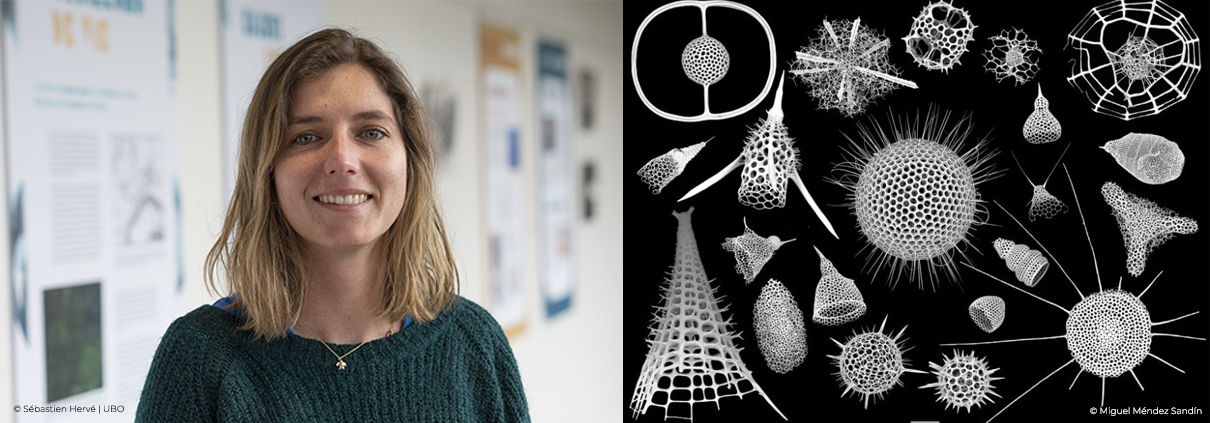
Thanks to Valentin Foulon, Natalia Llopis & to the radiolarians for this graphic creation.


Download the high resolution file here

Radiolarians and the silicon cycle: Natalia Llopis-Monferrer’s work in the spotlight!

The American Geophysical Union (AGU) has declared “Research Spotlight” the recent article by Natalia Llopis-Monferrer in “Global Biogeochemical Cycles” on the importance of radiolarians (marine planktonic organisms) in the silicon cycle of the world ocean.

This recent work re-evaluates the role of these tiny protists, which could contribute up to one-fifth of the world’s silica production by marine organisms.

Natalia Llopis-Monferer is a spanish student at LEMAR (UMR 6539). She is co-supervised by Aude Leynaert (CNRS), Fabrice Not (SBR) and Paul Tréguer (UBO).

Read the “EOS” article (Sciences News by AGU)

New guidelines for the application of Stokes’ models to the sinking velocity of marine aggregates

, ,

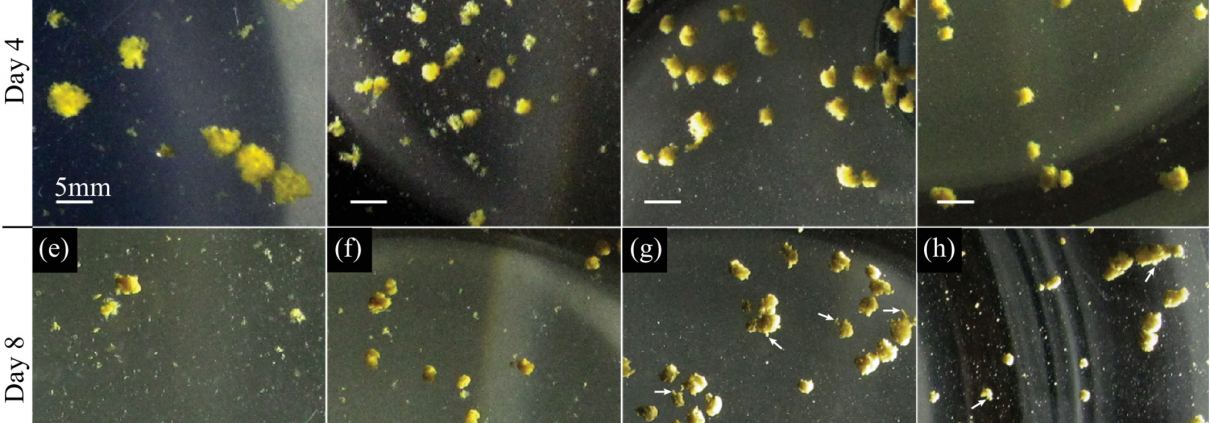
Numerical simulations of ocean biogeochemical cycles need to adequately represent particle sinking velocities (SV). For decades, Stokes’ Law estimating particle SV from density and size has been widely used. But while Stokes’ Law holds for small, smooth, and rigid spheres settling at low Reynolds number, it fails when applied to marine aggregates complex in shape, structure, and composition. Minerals and zooplankton can alter phytoplankton aggregates in ways that change their SV, potentially improving the applicability of Stokes’ models. Using rolling cylinders, we experimentally produced diatom aggregates in the presence and absence of minerals and/or microzooplankton. Minerals and to a lesser extent microzooplankton decreased aggregate size and roughness and increased their sphericity and compactness. Stokes’ Law parameterized with a fractal porosity modeled adequately size‐SV relationships for mineral‐loaded aggregates. Phytoplankton‐only aggregates and those exposed to microzooplankton followed the general Navier‐Stokes drag equation suggesting an indiscernible effect of microzooplankton and a drag coefficient too complex to be calculated with a Stokes’ assumption. We compared our results with a larger data set of ballasted and nonballasted marine aggregates. This confirmed that the size‐SV relationships for ballasted aggregates can be simulated by Stokes’ models with an adequate fractal porosity parameterization. Given the importance of mineral ballasting in the ocean, our findings could ease biogeochemical model parameterization for a significant pool of particles in the ocean and especially in the mesopelagic zone where the particulate organic matter : mineral ratio decreases. Our results also reinforce the importance of accounting for porosity as a decisive predictor of marine aggregate SV.

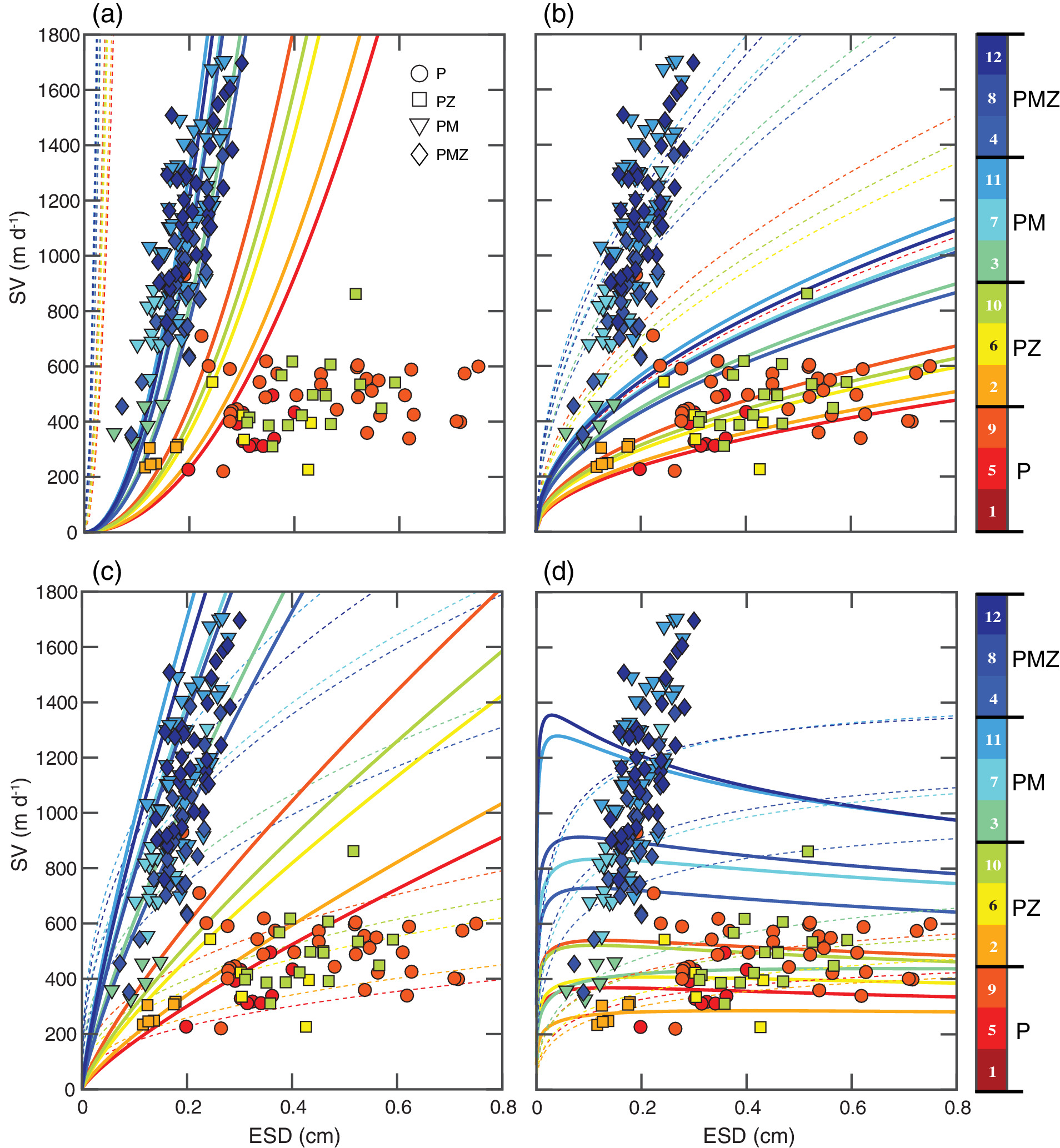
Sinking velocities vs. ESD (equivalent spherical diameter) for aggregates formed in each tank of the four treatments and comparison with theoretical expectations from different parameterizations of Stokes’ Law and the general Navier‐Stokes’ drag equation. P: phytoplankton; PZ: phytoplankton + microzooplankton (rotifers); PM: phytoplankton + mineral (calcite); PMZ: phytoplankton + mineral + microzooplankton. (a) Model 1, Stokes’ Law with constant porosities of 0% (dashed lines) and 99% (solid lines). (b) Model 2, general Navier‐Stokes’ drag law with constant drags of 1 (dashed lines) and 5 (solid lines), and a constant porosity of 99%. (c) Model 3, Stokes’ Law with a porosity scaled on a fractal geometry with coefficient a = 0.03 and D3 = 1.4 (dashed lines) and D3 = 1.8 (solid lines). (d) Model 4, general Navier‐Stokes’ drag law with a porosity scaled on a fractal geometry with coefficient a = 0.03 and D3 = 1.4 (solid lines) and 1.8 (dashed lines). See the text for details on drag calculation

Reference

Laurenceau-Cornec, E.C., Le Moigne, F.A.C., Gallinari, M., Moriceau, B., Toullec, J., Iversen, M.H., Engel, A., and De La Rocha, C.L. 2020. New guidelines for the application of Stokes’ models to the sinking velocity of marine aggregates. Limnol. Oceanogr. doi:10.1002/lno.11388.
Link to the journal:

Copyright : Laboratoire LEMAR- 2018