ECHOS thematic network

Active hydroacoustic study of aquatic ecosystems (ECHOS, 2025-2029)
Active acoustics is an observation method used to understand, assess and monitor the functioning of aquatic ecosystems. The ability of acoustics to observe ecosystem processes at multiple spatial and temporal scales promotes a better understanding of the ecosystem. The scope of application of active hydroacoustics encompasses all offshore, coastal, lagoon, estuarine and continental ecosystems from polar to temperate regions.
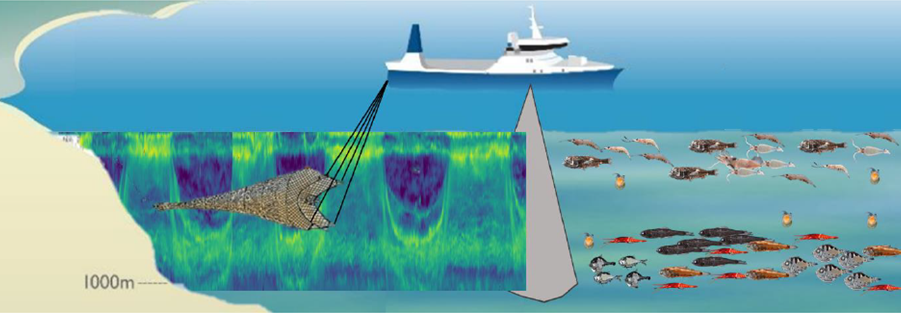
Illustration of sampling methods for pelagic and mesopelagic fauna, showing the position of a trawl net and an acoustic recording cone in relation to the layers of organisms (source: A. Receveur)
This discipline is part of the range of tools available to INEE to provide essential information on scientific issues and current societal challenges, such as climate change and overexploitation of resources. In France, many researchers and engineers are already working on these issues, but there is now a need to pool efforts by sharing scientific knowledge and defining new, interdisciplinary areas of research. The RT’s mission is to raise the profile of the French scientific community in this field, which has a wealth of expertise that is recognised internationally and needs to be developed and consolidated. The RT aims to bring together scientists (permanent staff, post-doctoral researchers and doctoral students) from around ten laboratories belonging to several French research organisations (CNRS, Ifremer, INRAE, MNHN, IRD).
The objectives of the RT ECHOS are to: (1) structure a heterogeneous and dispersed scientific community, (2) define common scientific and methodological barriers, (3) standardise observation protocols, (4) promote the exchange of expertise, and (5) ensure the dissemination of knowledge through workshops, conferences and training courses.
The programme is organised around four main areas in line with the guidelines defined by the international working group in this field, the ICES Working Group on Fisheries Acoustics, Science and Technology (WGFAST):
- Technologies and platforms: development and integration of new technologies (broadband echo sounders, acoustic cameras, eDNA, etc.) on various media (sailboats, drones, moorings, equipped animals) in order to collect data in environments that are difficult to access or sensitive.
- Organism detection and classification: improvement of acoustic diffusion models, particularly for understudied species (crustaceans, gelatinous organisms), and expansion of the frequency signature database.
- Data processing: use of artificial intelligence for the automatic analysis of large volumes of acoustic data, development of free and standard tools, and interoperability between databases.
- Ecological and societal applications: biodiversity monitoring, biomass estimation, study of trophic interactions, spatial management support (protected areas, wind turbine installation), and contribution to international conservation objectives.
Network actions
- Organisation of an annual meeting with the aim of promoting discussions and the presentation of work.
- Targeted assistance for the mobility of RT members: doctoral students, project development, participation in conferences.
- Organisation of technical workshops on specific topics and methodologies.
- Encouraging the sharing of expensive tools and workspaces, enabling the supervision of the use, loan and calibration of these tools
Network partners
CEBC, Chizé (CNRS) | CPS, Nouméa | Ifremer NSE, Plouzané | IPHC, Strasbourg (CNRS) | UMR BOREA, Dinard (MNHN) | UMR CARRTEL, Thonon-Les-Bains (INRAE) |UMR DECOD, Lorient, Nantes, Rennes (Ifremer, INRAE) | UMR ENTROPIE, Nouméa (IRD) | UMR LABSTICC, Plouzané, Brest (ENSTA, UBO) | UMR LEMAR, Plateforme d’acoustique active, Plouzané (IRD) | UMR LOCEAN, Plouzané, Paris (CNRS, MNHN) | UMR LOPS (IRD) | UMR MARBEC, Sète (Ifremer, IRD) | UR EABX, Bordeaux (INRAE)

Network coordination
Mathieu Doray (DECOD), Jean Guillard (CARRTEL), Jérémie Habasque (LEMAR), François Martignac (DECOD), Aurore Receveur (MARBEC), based on a network that has been active since 2003.
Contact : If you are interested in the network, please contact Jérémie Habasque.